Your team keeps correcting the AI. Can a small model learn from them?
Published
Before I suggest fine-tuning a model, I want to see what your team keeps fixing.
The product assigned to the wrong category. The customer request sent to the wrong department. The reply someone has to rewrite because it changes a fact.
There is useful information in those corrections. Someone has looked at the input, understood the business context and decided what the answer should have been. If you are doing that work repeatedly, I would want to know whether we can use it to reduce the next round of corrections.
That is a much more interesting starting point for me than choosing a model by its size.
The work hiding inside a correction
Suppose you run a retail catalog. Suppliers send descriptions in their own words, and your team sorts the products into your categories.
A supplier might call something a travel bag. Your staff know that its size and design put it under laptop bags in your catalog. They correct the category and move on.
If the system keeps repeating that mistake, the business pays for the same judgment again. Someone has to find the error, open the record and fix it before the product appears where customers expect it.
I would want to collect the original description alongside the corrected category. I would also ask about the difficult cases: products that could belong in two places, categories that overlap, and decisions different staff members make differently.
Those disagreements matter. Training a model on conflicting answers can teach it the confusion you hoped to remove.
What I would train it to do
Once the categories are clear, I can test whether a small model can learn to choose between them from the product description.
One approach is to train a classification head over the model's representation of the text. That head can be an MLP, a small neural network whose output scores the available categories.
I care about this because I can give the model a specific job and examine its mistakes. I can see whether it confuses laptop bags with travel bags, whether certain descriptions need more information, and whether it improves on the system your team already uses.
I would keep a separate set of products out of training for that comparison. Teaching the model yesterday's corrections is useful only if it helps with products it has not seen before.
Why I take the comparison seriously
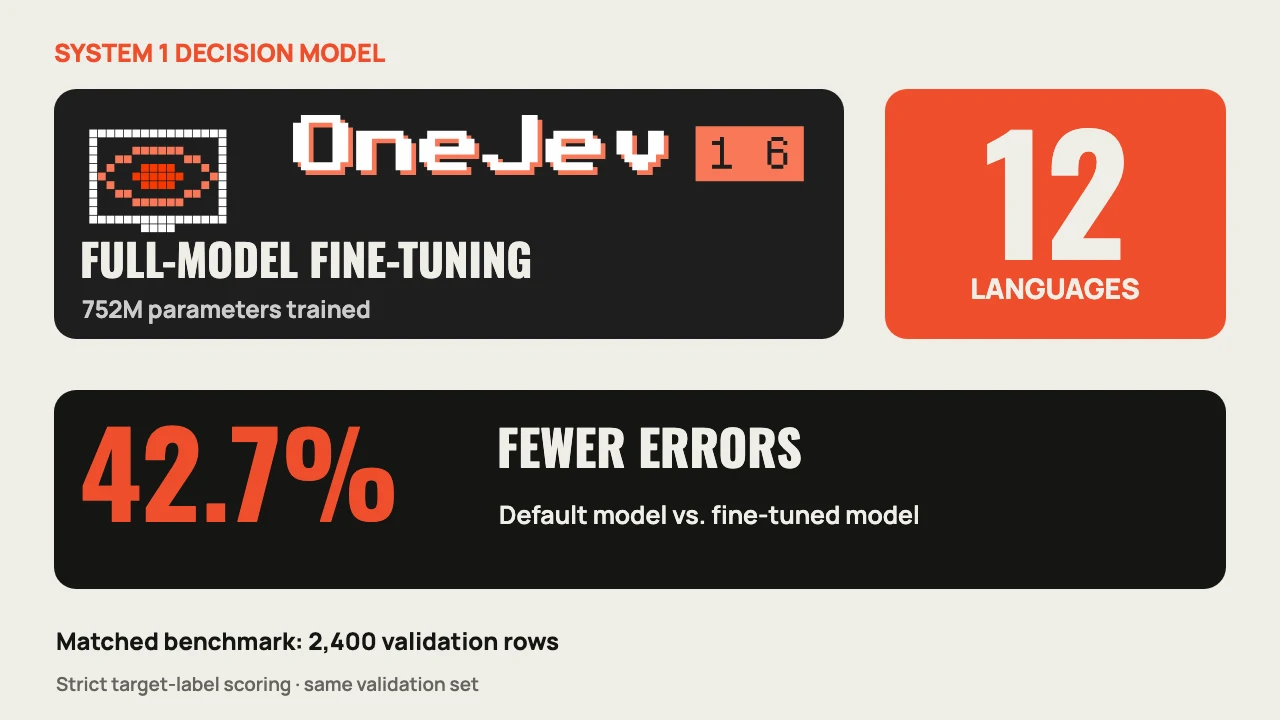
When I fine-tuned a 752-million-parameter OneJev model, I trained it to classify text into listener-response groups across 12 languages.
The task was different from retail categorization, but it gave me a concrete comparison of the same model before and after task-specific training. Strict target-label accuracy rose from 44.63% to 68.29% on the same 2,400 validation rows.
Those multilingual rows came from 200 original utterances. I split the source utterances before translation to keep versions of the same example from appearing in both training and validation.
I find that result useful because it shows both the improvement and the work still left to do. More than thirty percent of those validation decisions still missed the strict target label. I would need to understand those errors before deciding where the model could be trusted.
For your catalog, the equivalent question is practical: how many products can move through correctly, and how many still need someone to review them?
Corrections can teach response behavior too
Some corrections concern the wording that follows a decision. Your team may need to fix a reply because it changes a date, leaves out a detail or describes an action that has not happened.
With Gemma E4B, I trained the model to generate replies from supplied context and response policies. In matched checks, literal fact preservation improved from 47 out of 64 to 62 out of 64. Truncated replies fell from 19 to zero across 639 test cases.
I still found problems with negation and wording around backend actions. That is why I would keep the business decision and confirmed state under the application's control, even when a trained model writes the response.
For a team editing AI replies, I would turn the recurring corrections into specific checks. Then I could compare whether training reduces those failures on fresh examples, rather than relying on a few replies that read well.
The number I would want you to track
I would start with the amount of work your staff still have to redo.
For the retailer, that could mean category corrections per thousand incoming products and the time spent reviewing them. I would measure those alongside the model's errors and serving cost. A smaller model earns its place when the improvement is worth the effort of running and maintaining it.
There will be decisions that need a person, and rules the application should enforce directly. I would build those boundaries into the workflow rather than expect fine-tuning to make them disappear.
If your team already has a record of repeated corrections, I would look there before asking you to commission a new dataset. You may have been collecting the most useful examples while trying to get through the day's work.